Seminar 8 Inventory/warehouse management
SAP Conceptual Design
Since
for project 2 we are doing a conceptual design for Johnson & Johnson’s SAP
ERP system, James has been providing us more insights on how the SAP concepts
are related to each other and integrated as a whole picture. This time it was
an ERD including all the high level concepts, and we were to determine the
cardinalities between each of them. The whole diagram might seem complicated,
and some of the relationships are also straightforward. So here I just
highlight some points to refresh the memory.
For
company code and business area, the relationship is many-to-many. Each company
must be assigned to one company code, so that the accounting report and any
relevant documents like financial statements of the company can be created at
any time. Business area is also called business segment, and this is for
financial reporting purposes. For example, for JNJ case, the company may want
to generate the financial reporting separately by its 3 segments: Consumer Healthcare, Medical
Devices & Diagnostics, and Pharmaceuticals. There may be multiple companies
belonging to one business area, and a company can belong to different business
areas.
Next was credit control area.
Usually a company code can be assigned to only one credit control area, while a
credit control area can be in charge of multiple company codes. The
controversial part was whether the credit control should be centralized or
separated for different companies. If it is managed centrally, the customer’s
credit buy is under the same limit no matter from which company. If it is
separated, the different credit limits are applied, so generally the customers
can make more credit buys, but the company might suffer from the risk not
getting back money. It might depend on the situations. If you want an easy
control, it should be centralized; if different customer layers are to be
applied, separated credit control might be more appropriate.
 http://askross.ca
Another confusing point was the
difference between division and business area. These two can be set according
to the same business segments. As mentioned above, business area is more about
financial reporting, while division is related to the sales operation, like
pricing, discount rules etc. So division is directly connected to distribution
channel, and they have a many-to-many relationship. It is also connected to
company code, sales organization and plant.
 http://help.sap.com
The last point was plant. The
relationship of plant and company code is many-to-one, which means that a plant
can only be assigned to one company code. This is confusing because it is
reasonable that two companies are sharing one production plant or warehouse. So
it was clarified that plant is a logic concept, so two plants can share one
physical room but they are different plants. In addition, sales organizations
are supported by plants, and they have a many-to-many relationship. Multiple
purchasing organizations or business areas can also be assigned to a plant.
During the discussion and
elaborations I felt dozens of information rushing to me, and I need time to
digest. But maybe I have to be quick, because I think the information is very
helpful for our project 2!
Warehouse Management
I went to Legoland during recess
week, so I was so delighted to see those sweet little bricks! But the task was
not so sweet… We were to finish the tasks of warehouse workers. We need to
build the required shapes using bricks that had specified colours and number of
dots. The tasks must be completed as quickly as possible in order to beat other
groups. At first our group was doing quite well, but later on when other groups
have figured out well functioning “warehouse management systems”, we were left
behind. Some of the groups have divided
their “warehouse” (which was a piece of paper) reasonably, so it was more
efficient when looking for a specific brick. And they have also made some
changes on job allocation.
 http://74limelane.com.au
What can SAP bring us, while a
manual warehouse management system can already improve efficiency? SAP WMS can be integrated only if the company
already has a WMS. It allows material and inventory trace to the storage bin
level. This reduces the picking time and also provides a more precise look of what
was inside the warehouse for easier management. And again it enables the convenient
communication among departments.
But actually the system can be a
bit complicated and costly to use for the companies that do not have large or complex
warehouses.
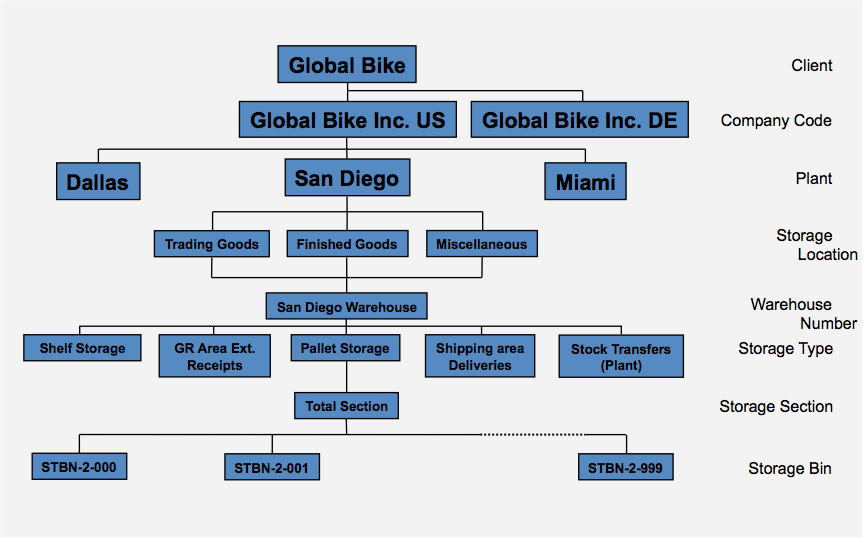
Lastly I think this diagram given
by James on Piazza really helped me understand the relationships among plant,
warehouse, and storage bins etc., so I just paste it here for reference later. :)

No comments:
Post a Comment