Saturday, April 19, 2014

Seminar 10

Seminar 10 Challenges of ERP Implementation

While keeping talking about the benefits and solutions that ERP system could bring to the organizations, people might forget that ERP system is not so easy-to-use. The implementation process is a large-scale and costly project that covers most departments of a company, and it might be risky. If the strategy is not chosen correctly, ERP may add some new problems or even ruin your business.

Case studies – Learn from failure

James told us to read some real life cases regarding ERP implementation, and to share the implications with classmates. The case that I’ve read was about FoxMeyer, once the fourth largest pharmaceutical distributor in the US. It decided to implement SAP system and integrate it with another warehouse automation system in 1994, when ERP system implementation had just got some success precedents. I can understand the aspiration to strive to be the first to apply new beneficial technology among the competitors, but haste makes waste. Without experienced consultants and effective control over the situation, the company seemed under pressure that caused by the project. The hardware system became over stressed, and employees were also afraid of losing jobs. The warehouse workers even deliberately destroyed the inventories and refused to fill in the orders. They should have halted the project, but due to profit overestimation, blind overconfidence, and social image maintenance, they chose to let it go. Finally, an overlarge contract eventually drove it into bankruptcy.    
From the cases that the classmates have shared with me, including Hershey, HP and Nike etc., there are some other problems that companies might encounter when implementing ERP system. I have consolidated them and as listed below.
  1. Not enough time spent on the project.
  2. Lack of experienced and knowledgeable consultants or technicians.
  3. Problems with the change of organizational structure.
  4. Hard to use SAP to centralize different sub-companies.
  5. Incorrect transaction volume estimation.
  6. Unsymmetrical information between the implementation team and the business process executives.


……
Some of the implications are also listed below:
  1. Think more before deciding to implement two systems together.
  2. Don't rush through the implementation process.
  3. Should not overly rely on external consultants.
  4. Effective trainings should be provided for any employees involved.
  5. Strong internal control should be applied to guide people to accept the changes.
  6. Back up plans should be prepared especially for peak hours.


……

Mini Debates

We then had some mini debates, which were also regarding ERP implementation. One of the motions seemed to be uncontroversial at all: Big bang approach is better than phase in approach when implementing ERP system. Maybe resulted from the unsuccessful cases above, we all became cautious and thought big bang approach should not be applied. But actually, these two approaches are just like blitzkrieg and seesaw battle, and you can’t say which one is better, because it needs to fit in some contexts. For example, big bang approach can be applied for a low cost project on a single site or multiple interdependent sites. And I found that the number of companies that applied big bang approach was roughly the same as the number of companies that applied phase in approach.


                                                                                              http://blog.softwareadvice.com

Another one that I thought interesting was: Consultants are friends, not foes. If you have learned organizational behaviour, you would say of course they should be treated as friends. But the opposite house stated that the consultants represent their own benefits, so they might provide wrong suggestions sometimes. Therefore, if you trust them as friends, you might get hurt.  But James said in reality, consultants are not treated friendly, because they are not deemed to belong here, and especially when they are young and getting paid better than the company’s manager. Having said that, I still think consultants should be treated as friends, because they are paid to be a strategic helper for the company. If they are feeling trusted, they might devote more and help more; otherwise, they might just finish their work and never think more from the company’s perspective.

The lessons have reached the end to some extends, and I think I’ve gained an understanding over the whole process, so that I would basically know what to do with SAP no matter which position I’m at in a company. And I think I’m going to gain more during the preparation of the SAP certificate test. More importantly, I’ve learned to be observant in daily life, so I believe I would get more insights regarding ERP with experiencing more in the near future J .


Friday, April 18, 2014

Seminar 9

Seminar 9 Supply Chain Management

Business process Jig-saw

So far we have covered all the sub-processes of a business process. Yes, the entire process is rather complicated, and it is not likely to understand every details of it merely after a one-semester course. But it is more important to form an integrated impression and be able to see the whole picture of it. So this is today’s first task. Our group was seeing it simply as a process loop.


Some other groups applied value chain concept and also covered some higher level processes. Below is a similar business process value chain.


                                                                       http://www.tcs.com


Project 1 Reflection

Next, James gave us some feedback regarding project 1. The most problematic part of project 1 was the netting in part 3. There are mainly 2 approaches to do this. The first one involves two steps, namely balancing customer side and vendor side and then doing the clearing. The second approach only need one step: clearing and posting the payments immediately. The latter was very easy to understand and conduct, so our group actually chose this approach.
However, what we haven’t considered was that in reality, the incoming and outgoing payments are in charge by different accounting people. In this case, who should be doing the netting? Therefore, it may make more sense to balance the payments first, and then some authorized people can check the balanced new item and do the netting accordingly. 

                                                                   http://www.inspiredbythis.com

I think we have neglected this point because we’ve got used to imagine self as the only staff in the company, just like when we were doing the labs. Although one person doing all the jobs would probably be overworking, sometimes it is easier to handle with fewer people. Remember that one of the largest benefits from SAP was solving the communication problem. However if all the things are done by myself, there isn’t any communication problem, because I know my whole plan and I know what I did last second. And of course, SAP also becomes less meaningful. So when playing around with SAP by ourselves, we are doing all the things, but we should think separately and really try to play the role of each employee.
Another insight from doing project 1 was that making things complicated is easier than making things simple. SAP has already simplified many processes, but I still can’t stop thinking in a complicated way. I was mainly in charge of part 2, which was to realize the function to receive order from the branch, to send invoice to branch, but receive the payments from head office. I was struggling to find a way to set the customer as the other customer’s head office and achieve the functionality. It turned out that there is a much easier way to do this: just set the head office as the payer for the branch. Sometimes we are doing unnecessary works without noticing it. It’s just like we want to eat egg, so we buy a pullet and try to raise her. It’s not just a waste of time but you may not reach your goal in the end.

                                                                               http://thecollegecrush.com

Supply Chain Management

We were randomly grouped and to play the mini supply chain game: The Beer Game. That was quite fun except for the internet connection problems…


                                                                    www.masystem.com
 

My company was losing money all the way…L I don't know what happened with other department, because we didn't have communications. The problem here was that I, being a producer, heard that the productions would be delayed for 2 weeks, so every week I kept producing a lot… I didn't have an overall production planning, and wrongly expected that the orders would grow in the future.
The solution would be the enhancement of coordination, so that the customer demand information collected from retailer could go through the supply chain and finally reach the producer. In this way, the excess inventory storage cost could be saved. ERP Supply Chain Management System is not the only solution here, but the key point is to integrate the information from companies involved and generate accurate sales forecasts.


Thursday, April 17, 2014

Seminar 8

Seminar 8 Inventory/warehouse management

SAP Conceptual Design

Since for project 2 we are doing a conceptual design for Johnson & Johnson’s SAP ERP system, James has been providing us more insights on how the SAP concepts are related to each other and integrated as a whole picture. This time it was an ERD including all the high level concepts, and we were to determine the cardinalities between each of them. The whole diagram might seem complicated, and some of the relationships are also straightforward. So here I just highlight some points to refresh the memory.
For company code and business area, the relationship is many-to-many. Each company must be assigned to one company code, so that the accounting report and any relevant documents like financial statements of the company can be created at any time. Business area is also called business segment, and this is for financial reporting purposes. For example, for JNJ case, the company may want to generate the financial reporting separately by its 3 segments: Consumer Healthcare, Medical Devices & Diagnostics, and Pharmaceuticals. There may be multiple companies belonging to one business area, and a company can belong to different business areas.
Next was credit control area. Usually a company code can be assigned to only one credit control area, while a credit control area can be in charge of multiple company codes. The controversial part was whether the credit control should be centralized or separated for different companies. If it is managed centrally, the customer’s credit buy is under the same limit no matter from which company. If it is separated, the different credit limits are applied, so generally the customers can make more credit buys, but the company might suffer from the risk not getting back money. It might depend on the situations. If you want an easy control, it should be centralized; if different customer layers are to be applied, separated credit control might be more appropriate.

                                                                            http://askross.ca

Another confusing point was the difference between division and business area. These two can be set according to the same business segments. As mentioned above, business area is more about financial reporting, while division is related to the sales operation, like pricing, discount rules etc. So division is directly connected to distribution channel, and they have a many-to-many relationship. It is also connected to company code, sales organization and plant.

                                                                    http://help.sap.com

The last point was plant. The relationship of plant and company code is many-to-one, which means that a plant can only be assigned to one company code. This is confusing because it is reasonable that two companies are sharing one production plant or warehouse. So it was clarified that plant is a logic concept, so two plants can share one physical room but they are different plants. In addition, sales organizations are supported by plants, and they have a many-to-many relationship. Multiple purchasing organizations or business areas can also be assigned to a plant.
During the discussion and elaborations I felt dozens of information rushing to me, and I need time to digest. But maybe I have to be quick, because I think the information is very helpful for our project 2!

Warehouse Management

I went to Legoland during recess week, so I was so delighted to see those sweet little bricks! But the task was not so sweet… We were to finish the tasks of warehouse workers. We need to build the required shapes using bricks that had specified colours and number of dots. The tasks must be completed as quickly as possible in order to beat other groups. At first our group was doing quite well, but later on when other groups have figured out well functioning “warehouse management systems”, we were left behind.  Some of the groups have divided their “warehouse” (which was a piece of paper) reasonably, so it was more efficient when looking for a specific brick. And they have also made some changes on job allocation.

                                                                        http://74limelane.com.au

What can SAP bring us, while a manual warehouse management system can already improve efficiency?  SAP WMS can be integrated only if the company already has a WMS. It allows material and inventory trace to the storage bin level. This reduces the picking time and also provides a more precise look of what was inside the warehouse for easier management. And again it enables the convenient communication among departments.
But actually the system can be a bit complicated and costly to use for the companies that do not have large or complex warehouses.
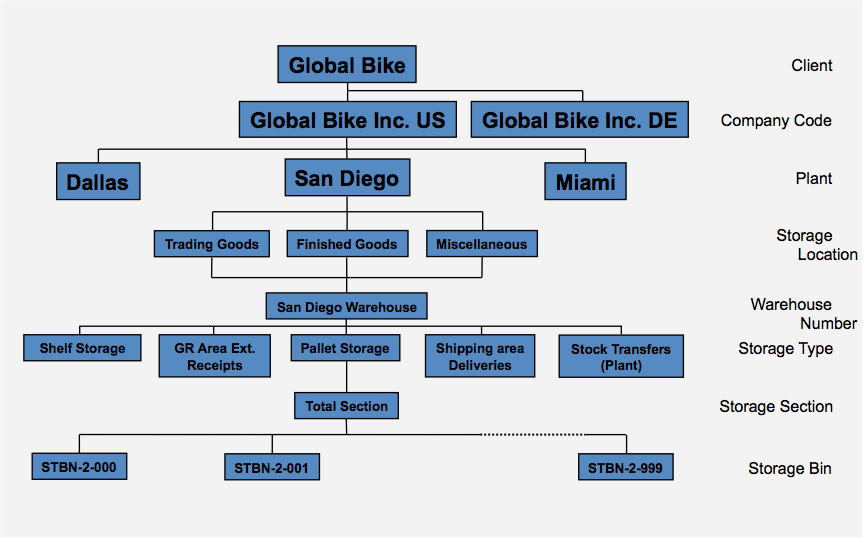
Lastly I think this diagram given by James on Piazza really helped me understand the relationships among plant, warehouse, and storage bins etc., so I just paste it here for reference later. :)


Monday, April 14, 2014

Seminar 7

Seminar 7 Manufacturing Execution

Although James reminded us that we have already made half way here, the arrival of project 2 is saying that there is still a long way to go… This feeling is like when in order to cheer you up, your friend says “There is only 20 days to the summer vacation!”, but what you hear is “There is only 2 weeks to the final exam!” Haha, just joking. Study is not easy, but it is easier than many other things, because you’ve achieved the goal once you have learned. So I’m quite ready to embrace the next learning opportunityJ!

Some Insights regarding ERP and Project 2

James always emphasizes the importance of connection from knowledge learned during class and lab to the experience and observation in real life. It is a bit hard for me, because I haven’t worked in a company. All that I can touch is a company’s sales department when I buy things from it, and marketing department when I seek sponsorship from it. But ERP is more like an internal management system, so I always ended with imagining the shape of it in the real cases. But today’s role play has opened a door for me to observe ERP in day-to-day life even without formal business processes. 
It was at a home, where some basic things, like sugar and salts are missing all the time, while other things are not able to be used up. The husband likes to buy things in large quantity, which is not always cheaper if the things bought are not necessary while necessities are not bought. The mother does not know how many dishes to cook, while the wife always plans out of expectation.  For example, the children have CCAs and won’t have dinner at home. And the maid is overwhelmed by the scattered ingredients and food, and makes wrong stock estimation. 
This role play was interesting not only in the sense of the funny performance of my classmates, but also in the sense of the embodiment of a mini company. The husband is purchasing department; the mother is manufacturing department; the wife is sales department, and the maid is warehouse. I was amazed by the exquisite analogy! The small business is facing problems like lack of key materials and waste of storage space for unnecessary materials and excess inventories etc. 
ERP indeed cannot solve all the problems. As stated in the Wiki for MRPII last time, the MRPII process needs both strong software management and strong human management. The employees of each department need to know how the process works besides the business skills within their own areas. Therefore, a clear vision and goal is significant, so that the employees can work towards the same direction with the organization.
Back to SAP, we all know that there are 3 sets of information to be kept in a customer master data, and we have different transaction codes to create a customer master data. So which one to use? What is encouraged by SAP is that finance department uses FD01, while sales department uses VD01, so that finance people will have general data and company code data (payments info etc.), and sales people will have general data and sales area data (shipping info, partner functions etc.). James then used a cube to help us understand the concept of sales area, which is the combination of each of the sales organizations, distribution channels and divisions.


Manufacturing Execution


Today’s student-led activity made us experience the process of manufacturing execution. I was allocated to the warehouse, and all I need to do was to receive and pass out inventory when necessary and update the inventory sheet. So most of the time I just sat there relaxingly watching the messy tables of accountants and producers… Of course I have discovered some problems. For example, I didn't know to whom I should pass the raw materials, so I just gave out the materials if I recognized that the person was from my “company”. Later the “real” receiver came and asked for the materials again, and he had to go and found the materials by himself. And accountants kept asking me how many hours I have worked, but this was decided by my supervisor. They also need to estimate other costs, which was very troublesome.
In this case, ERP system is able to change the way the roles were conducted, so employees could put more efforts on the coordination works to make the process more efficient. ERP usually cannot wipe out the roles. It even creates some new roles, like master data managers.
And there is a software system called Manufacturing Execution System (MES), which has some overlap with ERP system. Sometimes, ERP system needs to collaborate with other systems to perfect the functionalities and enhance the efficacy.

This seminar was quite interesting, and we got some cute box dolls produced by our classmatesJ.